

Why Berber Carpet Is Hard to Clean: A Homeowner’s Guide
Berber carpet is hard to clean because its continuous loop construction traps soil deep inside tight fiber gaps, and the most common fiber it’s made from — olefin (polypropylene) — repels water while attracting oils, which means standard wet-cleaning methods often push the problem deeper rather than lifting it out. The result is a carpet that looks clean right after a DIY steam session, then shows the same dark spots two days later. That phenomenon has a name: wicking, and it’s the single most common complaint Nashobapros hears from homeowners who’ve already tried to clean their Berber themselves.
Two things go wrong most often:
- Over-wetting causes brown-out. Because olefin fibers don’t absorb moisture, excess water carries dissolved soil into the backing. As the carpet dries from the bottom up, that soil wicks back to the surface — sometimes darker than before.
- Aggressive tools cause permanent damage. Vacuum beater bars and stiff brushes catch the loops, snag them, and create runs that no amount of cleaning will fix.
Table of Contents
- What “Berber” actually means — construction vs. fiber
- Why Berber carpet is hard to clean: the mechanics behind it
- Common problems you’ll see in real homes
- How professionals safely clean Berber
- Safe DIY steps — and what to avoid
- What cleaning cannot fix
- How often should Berber be professionally cleaned?
- When to call a professional and what to ask them
- Key Takeaways
- A local cleaner’s perspective on Berber
- Nashobapros offers fiber-aware Berber cleaning in the Nashoba Valley
- Useful sources and further reading
What “Berber” actually means — construction vs. fiber
Most people use “Berber” to describe a look: that flecked, low-profile carpet common in basements and high-traffic hallways. But technically, Berber refers to loop pile construction — yarn that runs continuously up from the backing, forms a loop at the surface, and goes back down, never cut. That looped structure is the root cause of nearly every carpet construction cleaning challenge Berber presents.
The fiber inside those loops varies, and fiber type changes everything about how you clean:
- Olefin (polypropylene): The most common Berber fiber. It has very low moisture absorbency, which sounds like a cleaning advantage but isn’t. Water sits on the surface or runs into the backing instead of being held in the fiber, and olefin is oleophilic — it actively attracts oils and greasy soils that are extremely hard to extract.
- Nylon: More absorbent and more resilient than olefin. It tolerates hot-water extraction better and bounces back from compression more readily, though the loop construction still creates risks.
- Wool: A natural fiber with real pH sensitivity. Alkaline cleaners can cause browning in wool loop pile because natural tannins and vegetative matter in the fiber react to high-pH chemistry. Wool Berber also costs more to replace, which raises the stakes considerably.
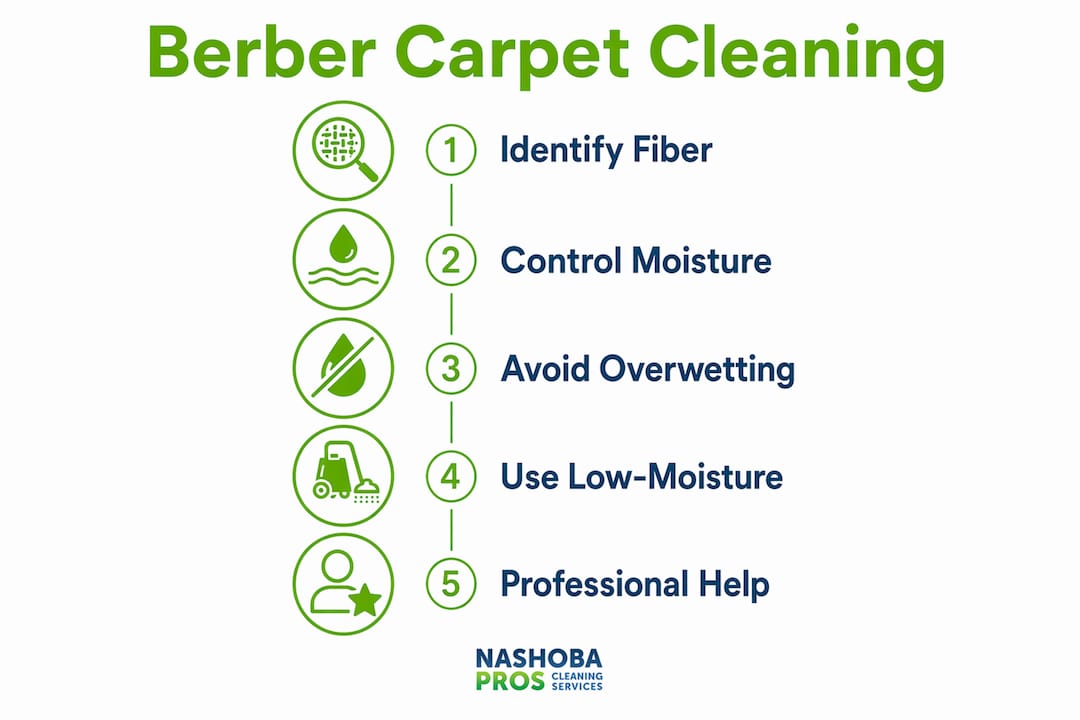
Understanding which fiber you have isn’t optional — it determines every decision that follows.
Why Berber carpet is hard to clean: the mechanics behind it
The difficulty isn’t one thing. It’s a combination of geometry, fiber chemistry, and the way moisture behaves under pressure.
Loop geometry limits access. Tight continuous loops create narrow gaps between fibers. Cleaning solution has trouble penetrating to the base of the loop, and suction has trouble pulling soil back out. Cut-pile carpet opens up when wet; loop pile stays closed. That structural difference is why cut-pile settings applied to Berber consistently produce poor results.
Wicking is a capillary action problem. When you apply too much water, it dissolves soil and drives it toward the backing. As the carpet dries, moisture evaporates upward through the pile — and it brings that dissolved soil with it. The spot reappears on the surface, often darker and more spread out than the original stain. This is wicking, sometimes called brown-out, and it’s not a sign that cleaning failed. It’s a sign that too much moisture was used.
The fiber chemistry makes this worse in predictable ways:
- Olefin’s low absorbency means water doesn’t stay in the fiber — it goes straight to the backing, accelerating wicking.
- Wool’s tannins react to alkaline detergents, producing brown patches that look like wicking but are actually a pH reaction requiring an acidic rinse to correct.
- Nylon handles moisture better but still carries loop-snag and compression risks.
Dry soil becomes abrasive when wet. Grit embedded in the loops grinds into the fiber the moment water is applied, making stains harder to lift and accelerating fiber wear. Thorough vacuuming before any wet work isn’t a preliminary step you can skip — it’s what makes the wet cleaning work at all.
Common problems you’ll see in real homes
Wicking and recurring spots are the most frequent complaint. A homeowner runs a rental steam cleaner over a stain, the carpet looks great, and then two days later the spot is back — sometimes with a brownish halo around it. That halo is soil that was sitting in the backing, dissolved by the cleaning water, and carried back up.
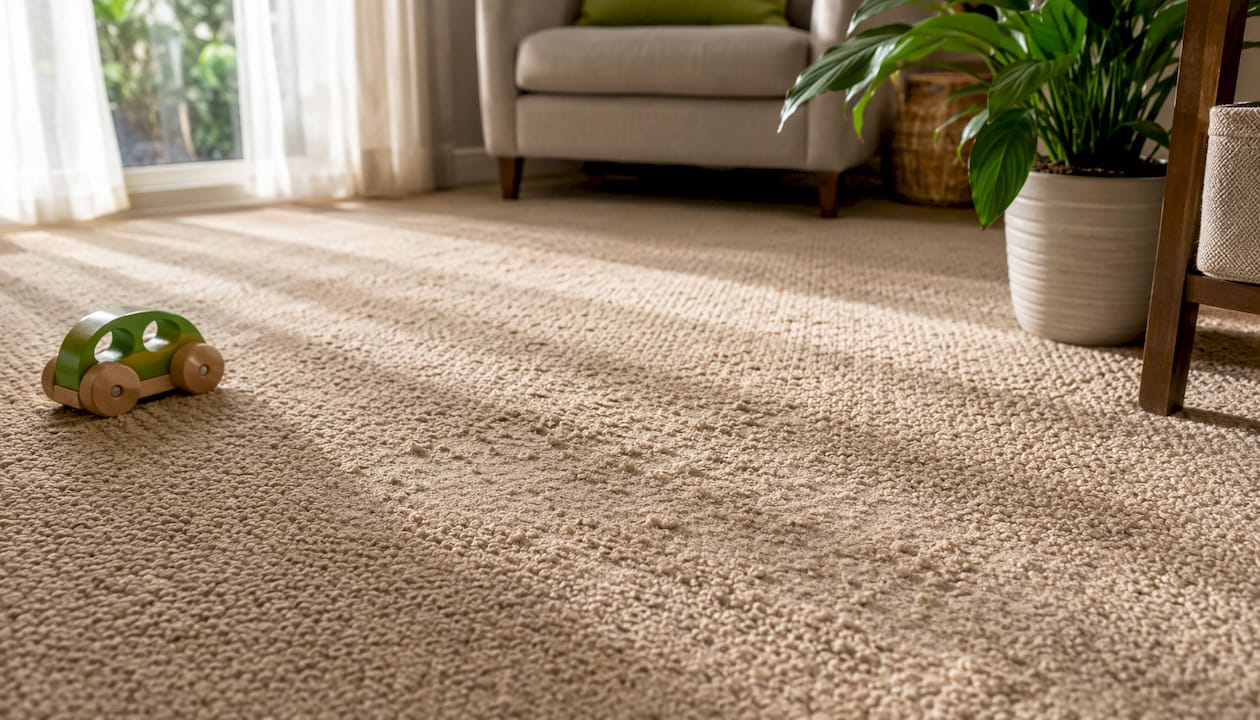
Pulled loops and runs happen when a vacuum beater bar, a furniture leg, or a dragged tool catches a loop. A snagged loop can propagate like a pulled thread, creating a visible run across the carpet. Once a loop breaks or pulls free, it cannot be restored to its original position. The practical fix is careful cutting of the loose strand, which leaves a small gap. Patching is possible but rarely invisible.
Fuzzing from aggressive agitation occurs when stiff brushes or rotary scrubbing tools break individual fibers, leaving frayed ends that stick up above the loop surface. Those frayed ends trap more dirt and make the carpet look perpetually worn.
Traffic lane darkening is a different problem entirely. Flattened loops change how light reflects off the surface, creating a shadowed, dirty-looking appearance in high-traffic zones even when the carpet is actually clean. Olefin’s oil attraction compounds this — greasy residue from foot traffic bonds to the fiber and darkens it further. No amount of cleaning restores crushed loops to their original height.
How professionals safely clean Berber
The professional approach to Berber is built around one principle: less moisture, more extraction. Every step in the sequence reflects that.
- Inspect fiber and backing first. Identify whether the carpet is olefin, nylon, or wool. Check for existing loop damage, browning, or prior wicking. Set realistic expectations with the homeowner before touching the carpet.
- Vacuum dry soil thoroughly. Use a suction-only head or raise the beater bar to its highest position. Experts recommend suction-only vacuums to avoid catching loops. Remove as much dry grit as possible before any liquid is applied.
- Pre-test chemistry. Test the cleaning solution in an inconspicuous area, especially on wool. Use neutral-to-mild pH chemistry on wool Berber; avoid anything alkaline.
- Apply solution sparingly. Meter the solution — light application, short dwell time. The goal is to loosen soil, not saturate the pile.
- Extract aggressively. Strong suction is the most important variable. Multiple dry passes (suction only, no additional water) after the wet pass pull residual moisture and dissolved soil out before they can wick back.
- Accelerate drying immediately. Fans, air movers, and dehumidifiers cut drying time dramatically. Controlled moisture and immediate airflow are what separate a professional result from a DIY one.
For olefin loop pile specifically, low-moisture encapsulation is often the preferred method. The cleaning agent crystallizes around soil particles as it dries, and the residue is vacuumed away — minimal moisture ever reaches the backing.
Pro Tip: Ask any pro you hire whether they perform dry passes after extraction. A technician who does one wet pass and packs up is leaving moisture in the backing. Dry passes are what prevent the wicking call-back.
Safe DIY steps — and what to avoid
Spot cleaning Berber at home is possible, but the margin for error is narrow.
What to do:
- Blot spills immediately with a clean white towel. Press down and lift; never rub. Work from the outside of the stain toward the center to avoid spreading it.
- For organic stains (food, coffee, pet accidents), an oxi-based spotter or an enzyme-based cleaner works well. For wool Berber, use a neutral-pH spotter specifically labeled safe for wool.
- Apply cleaner to the towel, not directly to the carpet. This controls how much moisture enters the pile.
- After blotting, press a dry towel onto the spot and weight it down for 10–15 minutes to pull residual moisture upward.
- For pet urine in Berber, enzyme-based products are the right choice — they break down the uric acid crystals that cause odor rather than just masking the smell.
What to avoid:
- Over-wetting. Pouring cleaner directly onto the pile is the fastest way to create wicking.
- DIY steam cleaners set to high moisture output. These machines are designed for cut-pile carpet and apply far more water than Berber can handle safely.
- Bleach or high-alkaline products on any Berber, especially wool.
- Stiff brushes or scrubbing motions. Blot only.
- Beater-bar vacuuming on loop pile.
If a spot returns after the area dries completely, stop rewetting it. Repeated rewetting makes wicking worse, driving soil deeper into the backing each time. Let it dry, assess, and call a professional if it comes back a second time. You can also review common household carpet stain types to identify what you’re dealing with before deciding on a treatment.
What cleaning cannot fix
Loop distortion is permanent. A loop that has been pulled, run, or crushed flat by heavy furniture cannot be restored by any cleaning method. The fiber is physically displaced. Patching or re-tufting can address pulled loops, but the repair is rarely invisible, especially on patterned Berber.
The appearance problem in high-traffic zones is also largely irreversible. Flattened loops reflect light differently from upright ones, creating a shadowed look that persists even after thorough sanitation. A carpet can be completely free of soil and still look dirty because of loop compression. This is one of the most frustrating aspects of Berber ownership — and one that salespeople rarely mention.
Stain-resistant surface treatments wear off over time, especially in high-traffic areas. Once that treatment is gone, the dense loops lock in greasy soils that are genuinely difficult to extract. If your Berber is more than a few years old and has seen regular foot traffic, assume the factory treatment has degraded in the areas that need it most.
How often should Berber be professionally cleaned?
The standard guidance for most carpets runs every 12–18 months for maintenance cleaning. Berber in high-traffic areas, homes with pets, or rooms with children often warrants annual service. The factors that determine cleaning frequency for Berber are the same as for other carpets, but the consequences of waiting too long are more severe because embedded soil is harder to extract from loop pile.
Several factors push the cost of a Berber job higher than a comparable cut-pile job:
- Fiber type. Wool Berber requires pH-specific chemistry, slower dwell times, and more careful rinsing — all of which add labor.
- Pre-existing wickback. If the carpet has already been over-wet by a DIY clean, a professional may need to address soil that has migrated deep into the backing, which takes more extraction passes and longer drying time.
- Equipment setup. Fans, air movers, and dehumidifiers add time and sometimes cost. Skipping them is how wicking happens.
- Return visits. Reputable cleaners disclose upfront that wickback can occur even with proper technique on heavily soiled Berber, and they build a recheck into the service. Budget for that possibility.
When to call a professional and what to ask them
Call a professional when a spot returns twice after drying, when you see visible pulled loops or runs, when you’re dealing with an oily or greasy stain, or when brown-out appeared after a previous cleaning attempt. DIY spot treatment has a ceiling, and pushing past it usually makes the underlying problem worse.
When you call, ask these questions directly:
- Do you identify the fiber type and backing before you start?
- What moisture-control methods do you use, and do you perform dry extraction passes?
- What equipment do you use on loop pile — suction-only wand or rotary head?
- Do you offer a recheck if wicking appears after the carpet dries?
Red flags: A technician who defaults to full-pressure hot-water extraction without adjusting settings for loop pile, or one who promises a single-pass fix for visible brown-out or loop runs, is telling you they haven’t worked much with Berber. Walk away. You can also review professional stain removal approaches to understand what a thorough service should include before you book.
Key Takeaways
Berber carpet’s loop construction and common fiber chemistry make moisture control the single most critical factor in every cleaning decision — more water almost always produces worse results.
| Point | Details |
|---|---|
| Keep moisture low | Over-wetting drives soil into the backing and causes wicking; less water with strong extraction outperforms more detergent. |
| Protect the loops | Avoid beater-bar vacuums and stiff brushes — a snagged loop can run and the damage is usually permanent. |
| Stop rewetting recurring spots | If a spot returns after drying, additional DIY wetting makes it worse; let it dry and call a professional. |
| Fiber type changes everything | Olefin, nylon, and wool each require different chemistry and moisture levels; identify the fiber before cleaning. |
| Nashobapros for Berber | Nashobapros uses fiber identification, controlled-moisture extraction, and forced drying with a satisfaction check after drying. |
A local cleaner’s perspective on Berber
Berber is the carpet that exposes the gap between a technician who adjusts their approach and one who doesn’t. After 30 years of cleaning homes in Westford and the Nashoba Valley, the pattern is consistent: the jobs that go sideways are almost always cases where someone applied cut-pile settings to loop pile, or where a homeowner’s well-intentioned DIY attempt pushed soil deeper into the backing before we arrived.
What Nashobapros does differently starts before the machine is turned on. We identify the fiber — olefin, nylon, or wool — and inspect the backing for existing moisture damage or wicking. That inspection changes the chemistry we use, the pressure we set, and whether we recommend encapsulation or controlled hot-water extraction. After the wet work, we set up airflow and don’t leave until drying is underway. If wicking appears after the carpet dries, we come back. That’s not a special offer; it’s part of how the job is done correctly.
Every product we use is pet-safe and family-safe, and our 100% satisfaction guarantee means you’re not left with a carpet that looks worse than when we started; for related advice on household surfaces, see Home Cleaning Archives | Peoria Illinois Interior Remodeler.
Nashobapros offers fiber-aware Berber cleaning in the Nashoba Valley
Berber done right takes longer, uses less water, and requires equipment settings most rental machines can’t replicate. Nashobapros brings 30 years of fiber-aware cleaning to every Berber job in Westford, MA and the surrounding communities — low-moisture options for olefin loop pile, controlled extraction for nylon and wool, forced drying to prevent wickback, and a follow-up check built into the service.

Whether you’re dealing with a recurring spot, visible brown-out from a previous clean, or a Berber carpet that just hasn’t looked right in years, we can assess it, explain what’s actually happening, and give you a clear plan. Most jobs in the Nashoba Valley area can be scheduled quickly. Get a free quote for carpet cleaning in Ayer, MA or call us directly to book — and ask about our satisfaction guarantee when you do.
Useful sources and further reading
- WoolSafe: The Cleaning and Maintenance of Wool Carpets — the authoritative technical guide on pH-appropriate chemistry and mechanical cautions for wool loop pile.
- Carpet Captain: Professionally Cleaning Berber Carpet — industry-facing breakdown of wicking, oil affinity, and why Berber requires adjusted settings.
- Masterful Carpet Cleaning: Berber and Loop Pile Cleaning — practical sequencing for dry passes, extraction, and accelerated drying to prevent wickback.
- Floor Covering Technologies: Cleaning Berber Carpet (technical brief) — technical guidance on pre-vacuuming and soil removal before wet work.
- Clean Gear Guide: Why Pet Stains on Berber Are Harder to Remove — explains loop distortion, light reflection, and appearance vs. sanitation.
- Nashobapros: How Carpet Construction Affects Cleaning Results — fiber and construction-specific guidance from the Nashobapros team.
- Nashobapros: Carpet Fiber Cleaning Requirements — covers olefin, nylon, and wool cleaning needs in plain language for homeowners.
- Nashobapros: Why Annual Professional Cleaning Extends Carpet Life — explains how regular maintenance prevents the irreversible appearance changes that affect Berber over time.