

How Long Carpet Takes to Dry After Cleaning
Most professionally cleaned carpets are surface-dry in 6–12 hours and fully dry within 24 hours under normal residential conditions using hot water extraction. That 24-hour mark matters more than most homeowners realize: IICRC S100 guidance treats residual moisture beyond 24–48 hours as an elevated risk for microbial growth, which means the clock starts the moment the technician leaves. The single fastest thing you can do right now is turn on your HVAC fan and point a box fan or air mover across the wet surface. That combination alone can cut your carpet drying time nearly in half.
Pro Tip: Don’t wait until the carpet feels dry to turn on airflow. Start fans and HVAC the moment the technicians finish, not hours later when you notice it’s still damp.
Light foot traffic in clean socks is generally fine after 2–4 hours. Full barefoot use and furniture replacement should wait until the carpet passes a simple dryness test, covered later in this guide.
Table of Contents
- How long does carpet take to dry after cleaning, by method?
- What factors affect how long your carpet takes to dry?
- How to dry carpet faster after cleaning
- When can you walk on carpet and put furniture back?
- What can go wrong when drying takes too long?
- How can you tell if your carpet is actually dry?
- What do professional technicians do to control drying?
- Key Takeaways
- What homeowners should actually expect from a professional cleaner
- Nashobapros cleans carpets and manages drying from start to finish
- Useful sources
How long does carpet take to dry after cleaning, by method?
The cleaning method your technician uses is the single biggest variable in how long you’ll be waiting. Hot water extraction (often called steam cleaning) introduces the most water and therefore takes the longest. Low-moisture methods sit at the other end of the spectrum.
| Cleaning Method | Surface Dry | Fully Dry |
|---|---|---|
| Hot water extraction (HWE) | 3–6 hours with active drying | 6–12 hours standard; 1–3 hours with industrial air movers |
| Bonnet cleaning | 1–4 hours | 1–4 hours |
| Encapsulation | 20–60 minutes | 20–60 minutes |
| Dry compound | Near-immediate | Under 1 hour |
| Shampoo (wet foam) | 4–6 hours | 12–24 hours |
Hot water extraction pushes heated water deep into the pile and then vacuums it back out. How much moisture stays behind depends heavily on the extractor’s suction power and how many passes the technician makes. Encapsulation and dry compound methods use little to no added water, which is why they dry so fast. Bonnet cleaning sits in the middle: it uses a spinning pad to absorb surface soil with moderate moisture, so drying is quicker than HWE but not as fast as encapsulation.
One caveat worth keeping in mind: these ranges assume average humidity, adequate ventilation, and a carpet in reasonable condition. A thick wool pile in a basement with no HVAC return will take longer regardless of method. For a deeper look at how cleaning methods compare on soil removal versus drying speed, that trade-off is worth understanding before you book.
What factors affect how long your carpet takes to dry?
Several variables interact during the drying process, and some of them are within your control.
- Cleaning method and water volume: More water introduced means more to remove. HWE uses the most; dry compound uses essentially none.
- Extractor suction power: A truck-mounted unit runs at 200°F+ and 300+ cfm of vacuum airflow, pulling far more moisture out of the pile than a portable machine. Operators report typical drying times of 4–6 hours with truck-mounts versus 8–12 hours for portables in similar conditions.
- Carpet fiber and pile height: Dense, high-pile carpets and natural fibers like wool hold more water and dry more slowly. Low-profile synthetic carpets shed moisture faster. If you have wool, expect the longer end of any range.
- Carpet pad type and condition: A thick foam pad acts like a sponge. If the pad is old or saturated, moisture wicks back up through the backing into the fiber tips during drying, which can make cleaned spots look dirty again even after the surface feels dry.
- Room ventilation and airflow: A closed room with no air movement is the worst-case scenario. Open doors, run ceiling fans, and keep the HVAC fan running.
- Indoor temperature: The recommended range is 70°F–80°F. Warmer air holds more moisture vapor, which speeds evaporation. Cooler rooms slow it down.
- Relative humidity: High outdoor humidity above 70%, indoor temps below 65°F, or sealed spaces like basements can add 4–8 hours to drying time and may require a dehumidifier to make any real progress.
Wicking deserves a specific mention because it catches homeowners off guard. When the pad or backing holds residual moisture, that moisture migrates upward through the fiber during drying, carrying dissolved soil with it. The surface looks dry, but spots reappear. Per IICRC guidance, the recommended approach is to allow full drying for up to 48 hours, vacuum from multiple directions, then lightly mist the area with distilled water and blot with a clean white towel to transfer the soil. Repeat as needed before calling for a re-clean.
Pro Tip: The two highest-leverage things you control are air movement and dehumidification. On a humid summer day in New England, a dehumidifier running alongside two fans matters more than anything else you can do.
How to dry carpet faster after cleaning
Getting airflow right is the priority, and the sequence matters.
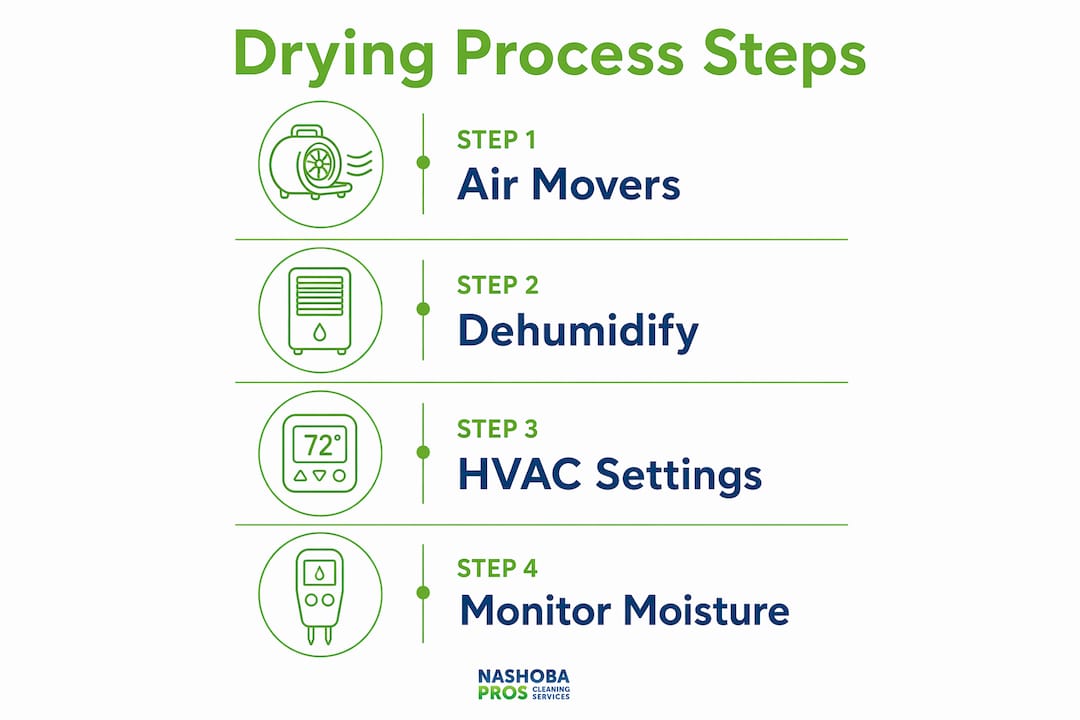
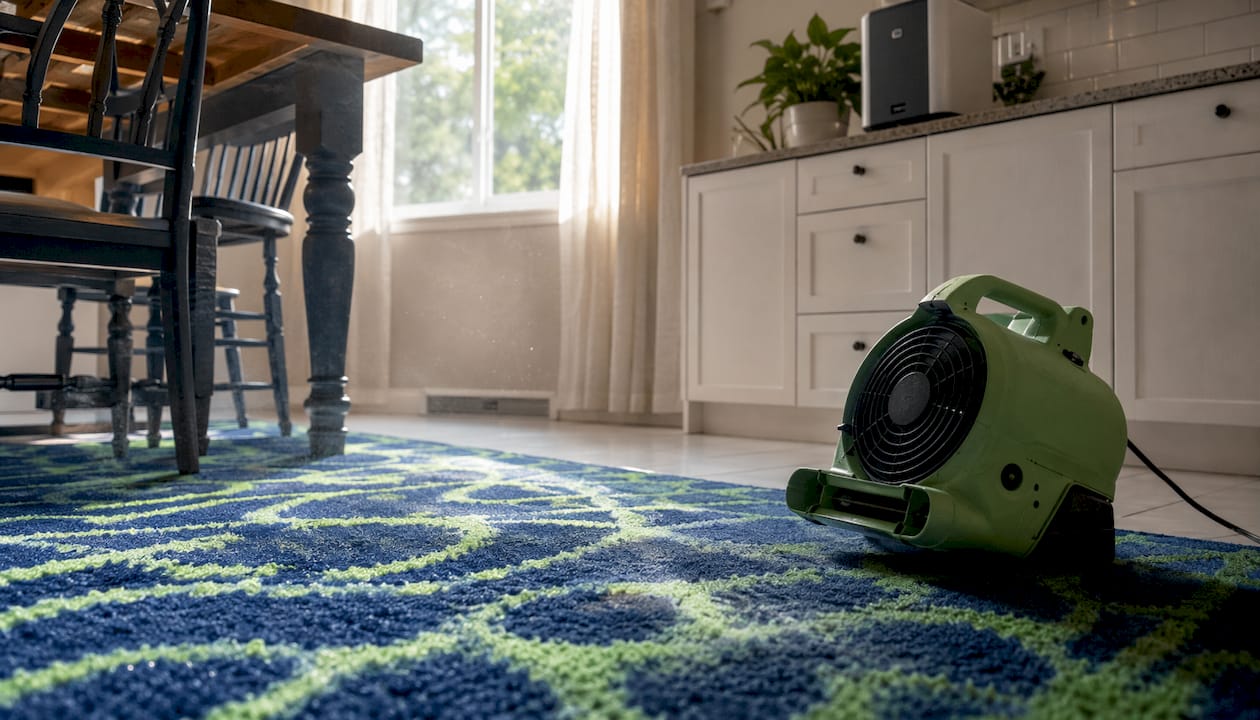
Air movers and fans first
Position fans or air movers to blow across the carpet surface at a low angle, not straight down. Angled airflow lifts moisture from the fiber tips into the room air more efficiently than vertical blowing. Two centrifugal air movers can cut drying time by roughly 50–65% compared to no active drying. If you don’t have air movers, two box fans pointed at low angles across the room will still make a meaningful difference. Keep interior doors open so moist air can escape rather than recirculate.
Add a dehumidifier on humid days
On days when outdoor humidity is high or the room feels muggy, a dehumidifier running alongside your fans can reduce drying time by an additional 20%. Place it near the center of the room or in the doorway where it can pull moist air from the largest area. Empty the reservoir every few hours or connect a drain hose if the unit supports it.
Run your HVAC correctly
Set the HVAC fan to “on” rather than “auto” so it runs continuously. In warm weather, air conditioning pulls double duty: it cools and dehumidifies simultaneously. In cold weather, running heat at a moderate setting keeps the room in the 70°F–80°F range without overheating. The CRI 205 residential standard specifically recommends running the HVAC fan, opening windows when outdoor conditions allow (sunny, low humidity), and never closing up a room with wet carpet.
Pro Tip: Skip the space heater. Direct high heat can damage carpet fibers and cause shrinkage, particularly in wool. Consistent moderate warmth with airflow beats a blast of concentrated heat every time.
If you want to prepare your home before the technicians arrive, clearing furniture and pre-setting your HVAC fan to “on” gives you a head start on drying before the job even finishes.
When can you walk on carpet and put furniture back?
Surface-dry and fully dry are not the same thing, and that distinction determines when it’s safe to return to normal use.
- Light foot traffic in clean socks: Generally safe after 2–4 hours, once the surface no longer feels wet to the touch.
- Barefoot walking and pets: Wait until the carpet passes the towel test (see the next section) and feels genuinely dry, typically 6–12 hours after HWE.
- Furniture replacement: The CRI 205 standard recommends waiting until the carpet is fully dry before replacing furniture. Place plastic or foil tabs under furniture legs to prevent color transfer if you need to move pieces back sooner.
- Heavy furniture: Wait the full 24 hours. Heavy items compress wet fibers and trap moisture underneath, which extends drying and can leave permanent marks.
- Checking under furniture placement areas: Press your hand firmly into the carpet where a piece of furniture will sit. If it feels even slightly cool or damp, wait another few hours.
Pro Tip: Keep a pack of furniture gliders or plastic carpet protector tabs on hand. Sliding them under legs for the first 24–48 hours protects both the carpet and the furniture finish while you wait for full dryness.
What can go wrong when drying takes too long?
Industry guidance from IICRC S100 is clear: residual moisture beyond 24–48 hours creates conditions favorable for microbial growth. That window is not a conservative estimate — it’s the threshold where a drying delay shifts from an inconvenience to a health and structural concern.
The risks compound quickly in poorly ventilated spaces. Mold can begin colonizing carpet backing and pad within that same 24–48 hour window, and once it reaches the subfloor, you’re looking at a remediation job rather than a re-clean.
Watch for these red flags:
- A persistent musty odor that remains after you’ve run fans and ventilation for several hours
- Carpet that still feels damp or cool to the touch more than 24 hours after cleaning
- Visible mold or dark discoloration near baseboards or seams
- Stains reappearing in the same spots after the carpet appeared dry (a sign of wicking)
- Rippling, bubbling, or delamination of the carpet backing
- Odors that worsen rather than improve as the carpet dries
If any of these appear, run additional air movers and a dehumidifier immediately. If the carpet is still damp at the 24-hour mark, contact your cleaning provider. Document what you’re seeing with photos and, if possible, note where the carpet feels wet. A sealed basement with no HVAC return is a particularly high-risk scenario; operators sometimes classify it as requiring a remediation protocol rather than standard cleaning. If persistent odors are a concern after drying, the causes of post-cleaning carpet smell are worth understanding before assuming the worst.
How can you tell if your carpet is actually dry?
The surface feeling dry underfoot is not enough. Moisture can remain in the backing and pad long after the fiber tips feel fine.
- Surface touch test: Press your palm flat against the carpet and hold for 3–5 seconds. Any coolness or dampness means moisture remains.
- White towel press test: Lay a clean white towel over the area and press firmly for 10 seconds. If the towel comes away dry, the surface is dry. If it picks up any moisture or soil, keep the fans running.
- Seam and edge check: Moisture lingers longest near baseboards and along seams. Run your fingers along the carpet edge where it meets the wall. If it feels damp there, the center likely still holds moisture too.
- Moisture meter reading: A professional-grade moisture meter inserted into the carpet and pad gives a definitive reading. Readings at or near ambient levels (typically below 15% for carpet) indicate full dryness. Ask your technician to take and document readings before they leave.
- Smell check: A faint clean or neutral odor is normal. A musty or sour smell after ventilation suggests moisture is still present in the backing or pad.
Pro Tip: Ask your technician to record their moisture readings at the start and end of the job. If you have a smartphone, photograph the meter display. That documentation matters if you need to follow up about damp spots or odors.
What do professional technicians do to control drying?
Good technicians treat drying as part of the job, not an afterthought. Per IICRC-style protocols, a properly run job includes documenting start and end times, placing air movers before leaving, taking moisture readings at multiple points, and verifying that readings are trending toward ambient levels within 24 hours.
Equipment choice has a measurable effect on how long you’ll wait:
| Equipment Type | Water Temp | Vacuum Airflow | Typical Drying Time |
|---|---|---|---|
| Truck-mounted extractor | 200°F+ | 300+ cfm | 4–6 hours |
| Portable extractor | Lower | Lower cfm | 8–12 hours |
The difference isn’t just speed. Higher vacuum airflow means more moisture is physically removed during the cleaning pass, leaving less for evaporation to handle. A truck-mount does more of the work mechanically; a portable leaves more of it to your fans and time.
Questions worth asking your cleaner at booking or on-site:
- Which method and equipment will you use?
- What drying window should I expect?
- Will you place air movers before you leave?
- Do you take moisture readings, and can I get a copy?
Setting accurate drying expectations at the time of booking is a mark of a professional operation. If a cleaner can’t answer these questions, that’s useful information before you schedule. Understanding how water pressure and extraction intensity affect residual moisture can also help you evaluate what a technician tells you.
Key Takeaways
Most carpets cleaned with hot water extraction are surface-dry in 6–12 hours and fully dry within 24 hours, but active airflow and a dehumidifier on humid days can cut that window significantly.
| Point | Details |
|---|---|
| Typical drying window | Surface-dry in 6–12 hours; fully dry within 24 hours for hot water extraction under normal conditions. |
| Highest-impact actions | Start fans and HVAC immediately after cleaning; add a dehumidifier on humid days for an additional 20% reduction. |
| 24–48 hour risk window | IICRC S100 identifies residual moisture beyond 24–48 hours as an elevated microbial growth risk. |
| When to call your cleaner | Carpet still damp after 24 hours, musty odor persisting after ventilation, or visible mold near baseboards. |
| Nashobapros approach | Nashobapros uses truck-mounted equipment, takes moisture readings, and communicates the expected drying window at booking. |
What homeowners should actually expect from a professional cleaner
Most of the drying-time advice online focuses on what you do after the technician leaves. That’s useful, but it misses something: a good cleaner should be setting your expectations before the job starts and managing moisture actively during it, not just handing you a “keep the windows open” tip sheet on the way out.
The 24–48 hour risk window from IICRC guidance isn’t a technicality. It’s the reason professional protocols include moisture documentation, not just cleaning documentation. When a technician places air movers, takes readings, and tells you the expected drying window at booking, they’re doing their job completely. When they don’t, the risk shifts to you.
Homeowners often underestimate how much equipment choice matters. The difference between a truck-mount and a portable extractor isn’t just speed; it’s how much moisture physically leaves the carpet during the job versus how much you have to evaporate afterward. Asking about equipment before booking is one of the most practical things you can do, and a cleaner who can’t answer that question clearly is worth reconsidering.
One more thing worth saying: surface-dry is not done. The backing and pad can hold moisture for hours after the fiber tips feel fine, and wicking is real. If spots reappear after drying, don’t assume the cleaning failed. Follow the distilled-water blot method from IICRC guidance first, give it another full day of airflow, and then call if it persists.
Nashobapros cleans carpets and manages drying from start to finish
Nashobapros has been serving Westford, MA and the surrounding Nashoba Valley communities for over 30 years. The difference you’ll notice isn’t just cleaner carpet; it’s that the drying process is handled as part of the job.

Every carpet cleaning job with Nashobapros includes truck-mounted extraction for maximum moisture removal, air mover placement before the crew leaves, moisture readings documented at the job site, and a clear drying window communicated at booking. Every product used is pet-safe and family-safe. If your carpet remains damp after the expected window, Nashobapros has a return and verification policy so you’re not left managing a moisture problem on your own.
For homeowners in the Nashoba Valley area, you can book carpet cleaning in Ayer, MA or request service in Lowell, MA online. Most jobs can be scheduled quickly. Get a free quote and ask about the expected drying window when you book.
Useful sources
These are the primary references used throughout this guide. Each one is worth bookmarking if you want the technical background behind any of the recommendations above.
- IICRC Tip Sheet: Carpet Topics — The consumer-facing summary of IICRC S100 guidance, covering drying protocols, wicking, and the 24–48 hour moisture risk threshold. The authoritative industry source for post-cleaning care.
- IICRC S100 Standard for Professional Cleaning of Textile Floor Coverings — The full ANSI-accredited standard that defines best practices for carpet inspection, cleaning, and drying. Referenced by professional technicians and used as a legal reference in the industry.
- CRI 205 Residential Carpet Standard for Maintenance and Cleaning — The Carpet and Rug Institute’s residential standard, including specific guidance on ventilation, furniture replacement, and the 12-hour drying target for homeowners.
- CRI 204 Commercial Carpet Standard for Maintenance and Cleaning — The commercial counterpart to CRI 205; useful for understanding how professional facilities manage drying and airflow at scale.
- Nashobapros Carpet Cleaning Services — Local service information for homeowners in Westford, MA and the Nashoba Valley area, including booking, equipment details, and service guarantees.