

Professional Rug Rotation Cleaning Benefits for Homeowners
Professional rug rotation cleaning is the most effective method to preserve your rug’s quality, appearance, and lifespan. The practice combines routine 180-degree repositioning with periodic professional deep cleaning to distribute wear evenly and remove contaminants that vacuuming cannot reach. The benefits of professional rug rotation cleaning include extended rug life, prevention of uneven fading, allergen removal, and long-term value protection. For homeowners with hand-knotted rugs, wool rugs, or high-traffic area rugs, this combined routine is the difference between a rug that lasts decades and one that deteriorates within years.
1. How does rug rotation prevent uneven wear and fading?
Rotation is the single most underused rug care habit in most homes. Foot traffic lanes, furniture legs, and direct sunlight all concentrate stress on the same fibers, day after day. Without rotation, uneven fading develops to the point where one side of a rug can be 2–3 shades lighter than the other within a decade.
The fix is straightforward. A 180-degree rotation every 6–12 months in standard traffic areas, and every 3–6 months in high-traffic or sun-exposed areas, redistributes that stress across the full surface. Fibers that were compressed under a sofa leg get a chance to recover. The side that faced a south-facing window now faces away from it.
The lifespan impact is significant. Routine rotation can double a hand-knotted rug’s lifespan by balancing wear patterns and avoiding concentrated traffic lanes that cause 50–100 times higher wear in localized spots. That is not a minor improvement. That is the difference between replacing a rug in 10 years versus 20.
Pro Tip: Always lift your rug when rotating it. Dragging damages edges and strains the foundation, causing curling and warped edges that are difficult to reverse.
Rug pads play a supporting role that most homeowners overlook. A quality pad acts as a shock absorber between the rug and the floor, reducing friction and helping the rug lie flat. Poor or worn pads lead to concentrated wear 50–100 times faster in unsupported areas. Replace your pad when it loses its grip or starts to break down.
- Rotate every 6–12 months in standard areas
- Rotate every 3–6 months in high-traffic or sun-exposed zones
- Always lift, never drag
- Inspect and replace worn rug pads at each rotation
2. What unique advantages does professional cleaning add beyond rotation?
Rotation manages wear distribution. Professional cleaning handles what rotation cannot: the buildup of deep soil, allergens, and contaminants embedded in the fiber structure. These are the threats that shorten a rug’s life from the inside out.
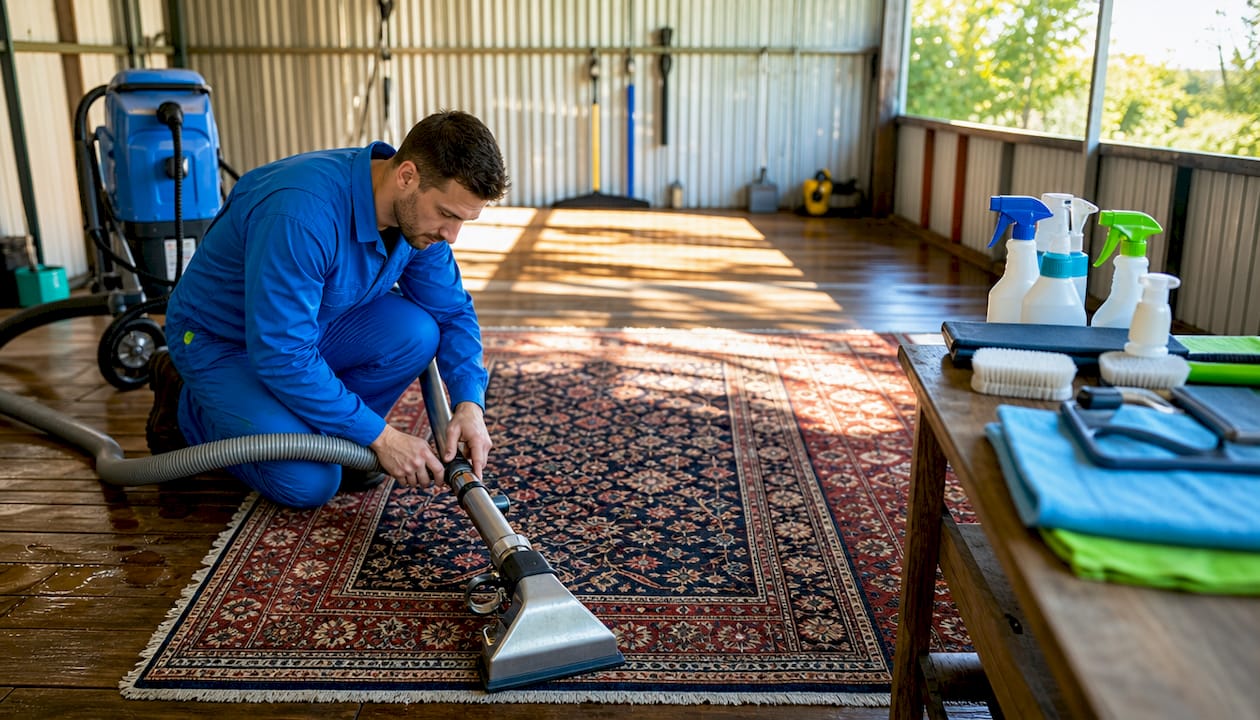
Vacuuming removes surface debris, but it does not extract the abrasive grit that settles at the base of fibers. Every step grinds that grit against the fiber, cutting it like sandpaper. Professional cleaning every 1–3 years removes this deep soil and extends rug lifespan 2–3 times beyond what DIY maintenance alone achieves. For households with children, pets, or allergy sufferers, that cleaning cycle matters even more.
Rugs function as indoor air filters. They trap dust mites, pet dander, and airborne pollutants in their fibers. Professional cleaning removes these contaminants far more effectively than vacuuming, improving household indoor air quality in a way that most homeowners never connect to their rugs. This is one of the most overlooked advantages of professional rug care.
The method matters as much as the frequency. Professional cleaning uses fiber-specific techniques and controlled drying that prevent shrinkage, mold growth, and fiber breakage. DIY wet cleaning attempts frequently cause these problems, especially with wool, silk, or hand-knotted rugs. Industrial extraction equipment pulls contaminants from beneath the surface without saturating the foundation.
Pro Tip: Schedule professional cleaning every 1–2 years for homes with pets or allergy sufferers, and every 2–3 years for low-traffic rooms. Understanding which rug types need professional care helps you set the right schedule for each rug in your home.
- Deep soil extraction removes abrasive grit that vacuuming leaves behind
- Allergen removal improves indoor air quality for the whole household
- Fiber-specific methods protect delicate materials like wool and silk
- Controlled drying prevents shrinkage and mold
- Professional equipment reaches contaminants below the surface
3. Key components of an effective professional rug rotation cleaning routine
A consistent routine is what separates rugs that age gracefully from rugs that wear out prematurely. The routine does not need to be complicated. It needs to be regular.
Weekly vacuuming forms the foundation. Use suction only, without a beater bar, to lift surface debris without stressing the fibers. Run the vacuum in the direction of the pile, not against it. This keeps the fiber structure intact between professional visits.
Spills require immediate attention. Blot the liquid with a clean, dry cloth. Never rub. Rubbing spreads the stain and pushes it deeper into the fiber. Blotting from the outer edge toward the center lifts the liquid without enlarging the affected area.
At each rotation, flip the rug and vacuum the underside. This step removes the grit and debris that falls through the pile and accumulates on the backing. It also gives you a clear view of the rug’s condition. Look for moth damage, fraying edges, worn spots, and pad deterioration. Catching these problems early prevents costly repairs later.
A comprehensive routine that includes weekly vacuuming, immediate spill blotting, biannual rotation with a flip-and-vacuum step, and professional cleaning every 1–3 years prevents buildup, evens wear, and detects damage before it becomes permanent.
- Vacuum weekly with suction only, in the direction of the pile
- Blot spills immediately; never rub
- Rotate every 6–12 months and vacuum the underside at each rotation
- Inspect for moth damage, fraying, and pad wear at every rotation
- Call professionals for stains that do not respond to blotting, heavy furniture relocation, or restoration needs
4. Professional rotation cleaning vs. DIY care: what actually differs
Most homeowners assume DIY care is “good enough” until they see the long-term results side by side. The gap between professional and DIY outcomes is widest for high-value, delicate, or heavily used rugs.
DIY care covers the surface. Weekly vacuuming and spot cleaning maintain appearance between professional visits, but they do not address fiber-level contamination. Professional cleaning requires specialized equipment and knowledge to safely clean without damaging fibers. That expertise is not replicable with a rented machine or a store-bought cleaning solution.
The cost argument for DIY care also weakens when you factor in replacement costs. Replacing a damaged rug costs far more than regular professional cleaning. For handmade or specialty rugs, professional maintenance is a cost-effective investment, not an optional luxury. Proper care protects both the appearance and the financial value of the rug long-term.
| Factor | Professional care | DIY care |
|---|---|---|
| Soil removal depth | Deep extraction below fiber base | Surface only |
| Allergen elimination | Thorough removal of dust mites and dander | Partial reduction |
| Fiber safety | Fiber-specific methods, controlled drying | Risk of shrinkage and mold |
| Wear distribution | Rotation scheduled and executed correctly | Inconsistent or skipped |
| Long-term rug value | Preserved and protected | Gradual decline |
| Best suited for | All rug types, especially delicate or high-value | Low-traffic, low-value rugs between professional visits |
For wool rug care and hand-knotted rugs, professional methods are not optional. The fiber structure of these rugs responds poorly to DIY wet cleaning, and the damage is often irreversible. For synthetic rugs in low-traffic rooms, DIY maintenance between professional visits is reasonable. The key is knowing which category your rug falls into.
Key Takeaways
Combining routine 180-degree rotation with professional deep cleaning every 1–3 years is the most effective way to extend rug life, prevent uneven wear, and protect indoor air quality.
| Point | Details |
|---|---|
| Rotate every 6–12 months | Distributes foot traffic and UV exposure evenly, preventing premature wear and fading. |
| Professional cleaning extends lifespan | Deep extraction removes abrasive soil and allergens that vacuuming cannot reach. |
| Lift, never drag | Dragging damages rug edges and foundations; always lift when repositioning. |
| Rug pads reduce concentrated wear | Quality pads prevent localized damage and help rugs lie flat between rotations. |
| Professional care protects rug value | For handmade and specialty rugs, professional maintenance costs far less than replacement. |
What 30 years of rug care taught me about rotation
Most homeowners treat rug rotation as optional. After three decades of seeing rugs in homes across the Nashoba Valley, I can tell you it is the single habit that separates rugs that last a generation from rugs that look tired in five years.
The part that surprises people most is this: rotation is preventive, not restorative. It will not reverse damage that has already happened. Once a traffic lane is worn bald or one side has faded significantly, rotation can only stop the problem from getting worse. That is why starting early matters so much.
What I have seen consistently is that homeowners who combine rotation with annual professional cleaning end up with rugs that look noticeably better at the 10-year mark than rugs that received neither. The difference is not subtle. The fibers are fuller, the colors are more even, and the structure is intact.
My practical advice: put your next rotation date on your calendar right now. Pair it with a professional cleaning appointment every 1–2 years if you have pets or kids, and every 2–3 years otherwise. These two habits cost far less than a replacement rug and deliver results that DIY care simply cannot match.
— Jim
Nashobapros keeps your rugs looking their best
Nashobapros has served Westford, MA and the surrounding Nashoba Valley communities for over 30 years. Every rug cleaning uses pet-safe, family-safe products and fiber-specific methods that protect your rug’s structure and color.

Whether you need a routine deep clean, allergen removal, or help with a rug that has seen years of heavy use, the Nashobapros team handles it without shortcuts. The HEPA filtration cleaning process removes contaminants that standard cleaning misses, improving indoor air quality alongside rug appearance. Schedule your professional rug cleaning today and get a free quote. Most jobs in the Westford area can be scheduled quickly, with results you will notice immediately.
FAQ
How often should I rotate my rug?
Rotate your rug every 6–12 months in standard traffic areas and every 3–6 months in high-traffic or sun-exposed rooms. Consistent rotation prevents uneven fading and concentrated fiber wear.
How often does a rug need professional cleaning?
Professional cleaning every 1–3 years removes deep allergens and abrasive soil that vacuuming cannot reach. Homes with pets or allergy sufferers benefit from cleaning closer to the 1-year end of that range.
Can I rotate my rug myself, or do I need a professional?
You can rotate most rugs yourself by lifting and repositioning them 180 degrees. Always lift rather than drag to avoid damaging edges and the rug’s foundation structure.
Does professional cleaning really improve indoor air quality?
Rugs trap dust mites, pet dander, and pollutants in their fibers. Professional cleaning removes these contaminants far more effectively than vacuuming, making a measurable difference for allergy sufferers and households with pets.
Is professional rug cleaning worth the cost for everyday rugs?
Replacing a damaged rug costs far more than routine professional cleaning. For any rug you want to keep for more than five years, professional care is a cost-effective investment that protects both appearance and structural integrity.