

HEPA Filtration in Carpet Cleaning: What You Need to Know
HEPA filtration is defined by the U.S. Department of Energy as a filter that captures at least 99.97% of airborne particles as small as 0.3 microns. The role of HEPA filtration in carpet cleaning goes far beyond surface appearance. Carpets trap dust mites, pet dander, pollen, and mold spores deep in their fibers. Standard vacuums pull those particles loose and push many of them right back into the air you breathe. A true HEPA system stops that cycle, making it one of the most effective tools homeowners have for improving indoor air quality.
How HEPA filters improve indoor air quality during carpet cleaning
Carpet acts as an allergen sink. It traps airborne particles like dust, pollen, pet dander, and mold spores that would otherwise stay suspended in the air. That sounds helpful until you vacuum. A standard vacuum disturbs those particles and sends a significant portion of them airborne again.
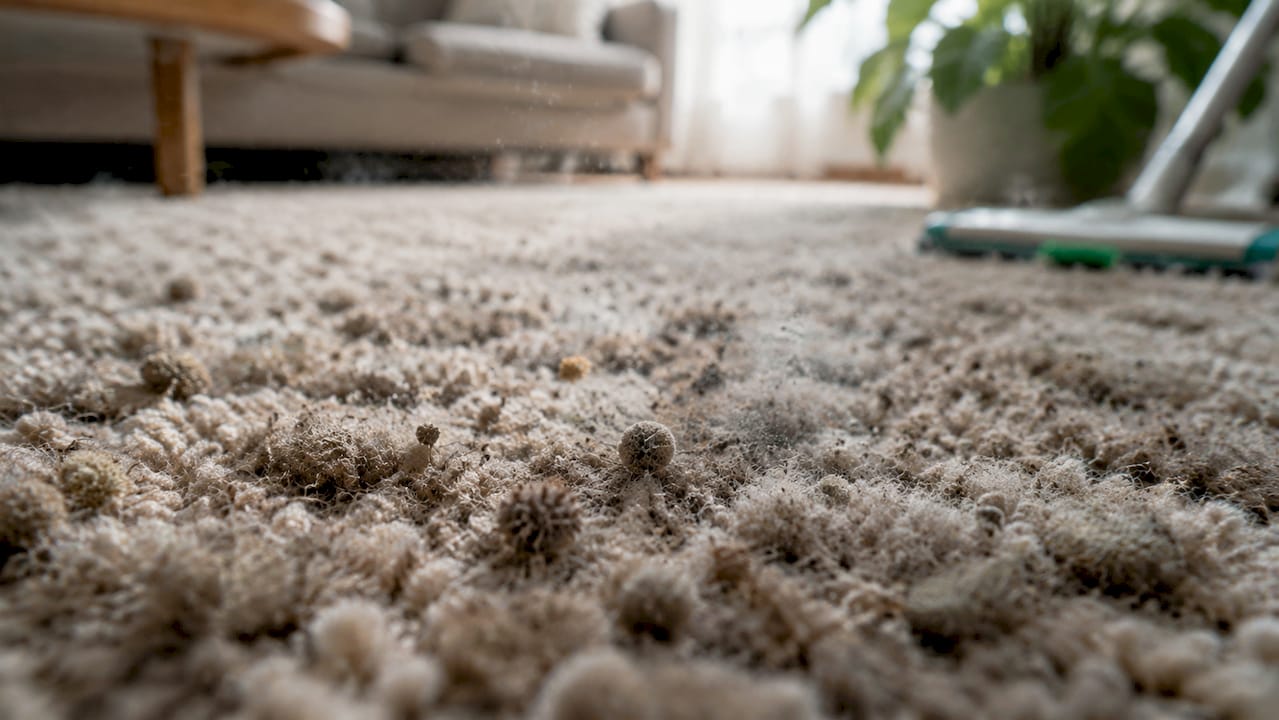
A HEPA vacuum breaks that cycle. The filter captures the fine particles that get stirred up during cleaning, so they end up in the dustbin instead of your lungs. The Asthma and Allergy Foundation of America recognizes regular HEPA vacuuming as a meaningful strategy for reducing indoor allergy triggers. That matters for anyone in your household who deals with asthma, hay fever, or pet allergies.
The benefits are real, but only if you vacuum often enough to keep up with particle buildup. Here is what the research supports:
- Homes with pets or allergy sufferers should vacuum with a HEPA-certified machine at least once a week to prevent fine allergens from re-circulating.
- High-traffic areas like hallways and living rooms accumulate particles faster and may need more frequent attention.
- Low-traffic bedrooms can typically be maintained with bi-weekly HEPA vacuuming.
- After outdoor events or seasonal peaks like spring pollen season, an extra vacuuming session makes a measurable difference.
Pro Tip: Run your HEPA vacuum slowly over each section of carpet. Moving too fast reduces the contact time between the suction head and the fibers, which means more allergens stay behind.
Why sealed HEPA vacuum systems matter more than the label
Owning a vacuum with a HEPA filter does not automatically mean you are getting HEPA-level filtration. Experts stress vacuum construction over filter media alone. A HEPA label is ineffective if the vacuum lacks a fully sealed air path from intake to exhaust.
Here is the problem. If the housing around the filter is not airtight, air finds the path of least resistance. It leaks around the filter instead of passing through it. Non-sealed HEPA vacuums can allow 30–60% of fine particulates to bypass the filter entirely and return to the room. That defeats the entire purpose of HEPA technology.
A genuinely sealed system has several key components working together:
- Airtight housing that forces all air through the HEPA media with no gaps or cracks.
- Quality gaskets around the filter that create a secure seal and prevent bypass.
- Secure dustbin connections that do not allow leakage at the point where the bin meets the body.
- Sealed exhaust ports that direct filtered air out through the HEPA media, not around it.
When shopping for a HEPA vacuum, look for models that are labeled as “sealed system” or “fully sealed HEPA.” Some manufacturers use the term “True HEPA” to indicate both the filter standard and a sealed construction, but verify the sealed system claim specifically. A HEPA filter in a leaky body is just an expensive piece of paper.
Pro Tip: Hold a thin tissue near the exhaust port of your vacuum while it runs. If the tissue moves significantly, air is escaping without full filtration. A properly sealed system produces a steady, controlled exhaust flow.
How HEPA vacuuming fits into professional carpet cleaning methods
HEPA vacuuming and professional deep cleaning are not competing approaches. They work best together. Cleaning experts recommend combining frequent HEPA vacuuming with regular professional steam cleaning to handle both daily maintenance and deep allergen removal.
Hot water extraction, also called steam cleaning, is the industry gold standard for deep carpet cleaning. It injects hot water and cleaning solution deep into carpet fibers and extracts it along with dissolved soils, bacteria, and allergens. No dry vacuuming method reaches that level of deep cleaning. But hot water extraction works best when the carpet has been properly pre-vacuumed first.
Skipping HEPA pre-vacuuming before wet extraction creates a specific problem. Dry soil particles mix with the injected water and form a paste. That paste pushes deeper into the carpet backing, becomes harder to extract, and can lead to mold growth or persistent odors. Pre-vacuuming with HEPA equipment is the most critical and most overlooked step in the professional cleaning process.
Here is how an effective integrated cleaning sequence looks:
- HEPA pre-vacuum the entire carpet to remove dry soils, pet hair, and surface debris before any moisture is introduced.
- Apply a pre-treatment solution to break down embedded grease and protein-based stains.
- Perform hot water extraction using professional-grade equipment to flush and extract deep soils and allergens.
- Allow adequate drying time before walking on the carpet. Proper airflow and ventilation speed this up.
- Resume regular HEPA vacuuming between professional cleanings to maintain the results.
| Step | Purpose | HEPA Involvement |
|---|---|---|
| Pre-vacuuming | Remove dry soils before wet cleaning | Required: HEPA vacuum |
| Hot water extraction | Deep flush of embedded allergens | Professional equipment |
| Drying | Prevent mold and odor | Ventilation, no HEPA needed |
| Ongoing maintenance | Prevent allergen buildup | Required: HEPA vacuum |
You can read more about how hot water extraction works and why pre-vacuuming is so critical to the outcome.
How to maintain HEPA filters for lasting performance
A clogged HEPA filter does not just reduce allergen capture. It reduces suction power across the entire vacuum, which means the machine picks up less of everything. HEPA filters accumulate microscopic debris over time, and that buildup degrades both airflow and filtration efficiency. Maintenance is not optional.
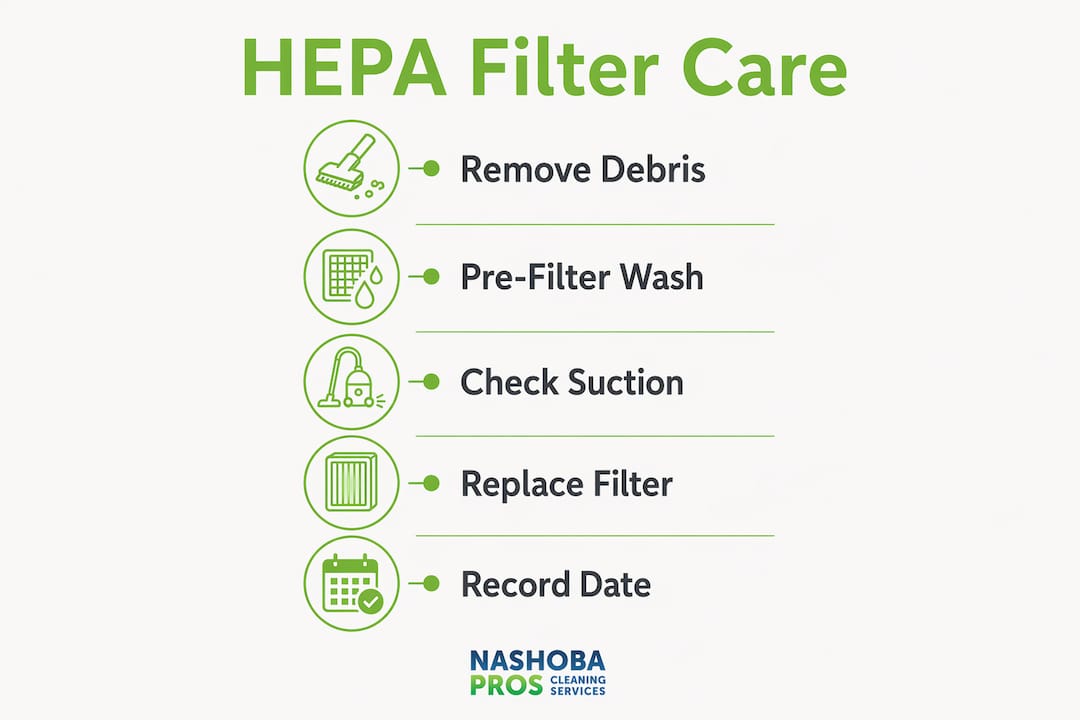
The Washington State Department of Health recommends replacing HEPA filters every 3–12 months depending on usage. A household with pets and allergy sufferers that vacuums weekly sits at the high-use end of that range. A single-person home with no pets and light vacuuming sits at the low-use end.
Watch for these signs that your HEPA filter needs attention:
- Reduced suction that does not improve after emptying the dustbin.
- Visible discoloration on the filter media, indicating heavy particle loading.
- Musty or dusty odor coming from the exhaust, which signals filter saturation.
- Allergy symptoms returning despite regular vacuuming, which often points to a compromised filter.
- It has been more than 12 months since the last replacement, regardless of how the vacuum feels.
Pairing your HEPA filter with a washable pre-filter extends its life significantly. The pre-filter catches larger particles before they reach the HEPA media, slowing the rate of clogging. Many vacuum manufacturers include pre-filters for exactly this reason. Rinse the pre-filter monthly, let it dry fully before reinstalling, and your HEPA filter will last closer to the longer end of the replacement range.
Pro Tip: Write the replacement date on a small piece of tape and stick it directly to your vacuum. You will never have to guess when you last changed the filter.
Key takeaways
HEPA filtration is the single most effective tool homeowners have for reducing allergen recontamination during carpet cleaning, but only when the vacuum uses a fully sealed system and the filter is replaced on schedule.
| Point | Details |
|---|---|
| HEPA standard | A certified HEPA filter captures at least 99.97% of particles at 0.3 microns. |
| Sealed systems matter | Non-sealed vacuums can allow 30–60% of fine particles to bypass the filter. |
| Pre-vacuuming is critical | HEPA vacuuming before hot water extraction prevents soil paste and mold risk. |
| Replace filters regularly | Replace HEPA filters every 3–12 months based on household usage and pet presence. |
| Integrated approach wins | Frequent HEPA vacuuming combined with professional deep cleaning delivers the best results. |
What 30 years of carpet cleaning taught me about HEPA filtration
Most homeowners focus on how their carpet looks after cleaning. I focus on what the air smells and feels like an hour later. That shift in perspective changes everything about how you approach the job.
The most common mistake I see is homeowners buying a vacuum with a HEPA filter and assuming the work is done. The filter is only part of the equation. If the housing leaks, the filter is irrelevant. I have seen expensive vacuums with impressive HEPA specs that performed worse than simpler sealed-system models because the construction was poor.
The second mistake is skipping pre-vacuuming before a professional cleaning. People assume the steam cleaning will handle everything. It does not. Wet extraction is designed to flush dissolved soils, not to manage dry particulate. When you skip the HEPA pre-vacuum step, you are setting up the wet cleaning to work harder and deliver less.
What actually works is simple: vacuum with a sealed HEPA machine at least once a week, replace the filter on schedule, and bring in a professional for deep allergen removal two to four times a year depending on your household. That combination keeps carpets genuinely clean, not just visually clean. The health difference is real, and your family will feel it.
— Jim
Professional carpet cleaning with HEPA-grade results in Westford, MA
Nashobapros has served homeowners across Westford and the Nashoba Valley for over 30 years. Every carpet cleaning job starts with proper HEPA pre-vacuuming before hot water extraction, because skipping that step costs you results.
If you are ready for carpets that are genuinely clean and not just surface-level fresh, Nashobapros is ready to help. All products used are pet-safe and family-safe. Scheduling is fast, and most jobs can be completed quickly. Check how often your carpets need cleaning to plan your next service, or get a free quote for professional carpet cleaning in Maynard, MA and surrounding areas today.
FAQ
What does HEPA filtration mean in a vacuum?
A HEPA filter captures at least 99.97% of airborne particles as small as 0.3 microns, which is the most penetrating particle size. Particles both smaller and larger than 0.3 microns are trapped with even higher efficiency.
Is a HEPA label enough when buying a vacuum for carpet cleaning?
A HEPA label alone is not enough. Experts emphasize sealed system design as the critical factor, because a HEPA filter in a leaky housing allows a significant portion of fine particles to bypass the filter entirely.
How often should I vacuum carpets with a HEPA vacuum?
Homes with pets or allergy sufferers should vacuum at least weekly with a HEPA-certified machine. High-traffic areas may need more frequent attention to prevent allergen buildup.
When should I replace my HEPA filter?
Replace your HEPA filter every 3–12 months depending on how often you vacuum and whether you have pets. Signs of a failing filter include reduced suction, musty exhaust odor, and returning allergy symptoms.
Does HEPA vacuuming replace professional carpet cleaning?
HEPA vacuuming and professional cleaning serve different purposes. HEPA vacuuming manages surface and mid-level allergens between visits, while hot water extraction flushes deeply embedded soils and allergens that no vacuum can reach on its own.