

How Hand-Knotted Rug Cleaning Works: A Homeowner’s Guide
Most homeowners treat their hand-knotted rugs the way they treat wall-to-wall carpet: a quick vacuum, the occasional spot treatment, and maybe a rental steam cleaner once a year. That approach works fine for synthetic carpet. For a hand-knotted rug, it can quietly destroy the piece. Understanding how hand-knotted rug cleaning works, and what separates it from generic carpet care, is the first step to protecting something that can hold significant financial and sentimental value for decades.
Table of Contents
- Key takeaways
- How hand-knotted rug cleaning works: understanding the structure first
- The professional cleaning process, step by step
- At-home maintenance between professional cleanings
- Signs your rug needs professional attention
- Why I think most homeowners wait too long
- Protect your rug with Nashobapros
- FAQ
Key takeaways
| Point | Details |
|---|---|
| Professional cleaning is different | Hand-knotted rugs need full immersion washing, not steam or surface cleaning. |
| Natural fibers are vulnerable | Wool and silk react poorly to harsh chemicals, heat, and mechanical agitation. |
| Home care extends intervals | Weekly vacuuming with proper technique reduces how often professional cleaning is needed. |
| Cleaning frequency matters | Most hand-knotted rugs need professional washing every one to three years depending on traffic. |
| Warning signs are specific | Dull color, persistent odors, and fraying edges all signal that professional attention is overdue. |
How hand-knotted rug cleaning works: understanding the structure first
Before anything about cleaning makes sense, you need to understand what you are working with. A hand-knotted rug is not manufactured on an assembly line. Skilled weavers individually tie thousands of knots, one at a time, around the warp threads that form the rug’s foundation. A single 9×12 rug can contain anywhere from half a million to several million knots depending on the origin and quality. That foundational structure is what gives these rugs their durability and their value, and it is also what makes careless cleaning so destructive.
The fibers themselves add another layer of complexity. Most hand-knotted rugs use natural materials like wool, silk, or cotton, each of which behaves very differently from synthetic nylon or polyester.
- Wool contains natural lanolin, an oil that gives the fiber resilience and a natural resistance to soiling. Harsh detergents strip that lanolin permanently.
- Silk is exceptionally fine and sensitive to pH levels. Even mild alkaline cleaners can cause silk fibers to weaken or discolor.
- Cotton foundations (the vertical warp and horizontal weft threads) shrink when exposed to excess moisture or heat, which can warp the entire rug structure.
This is the sharpest contrast with machine-made or hand-tufted rugs. Hand-tufted rugs use a backing of latex glue to hold tufts in place, which actually dissolves or separates with full immersion. Hand-knotted rugs, because of their knotted structure, can safely undergo full immersion wet cleaning, something that would ruin a hand-tufted piece.
Pro Tip: If you are not sure whether your rug is hand-knotted, look at the back. Hand-knotted rugs show an irregular, slightly raised pattern of individual knots. Machine-made rugs have a perfectly uniform, mechanical pattern on the reverse.
The professional cleaning process, step by step
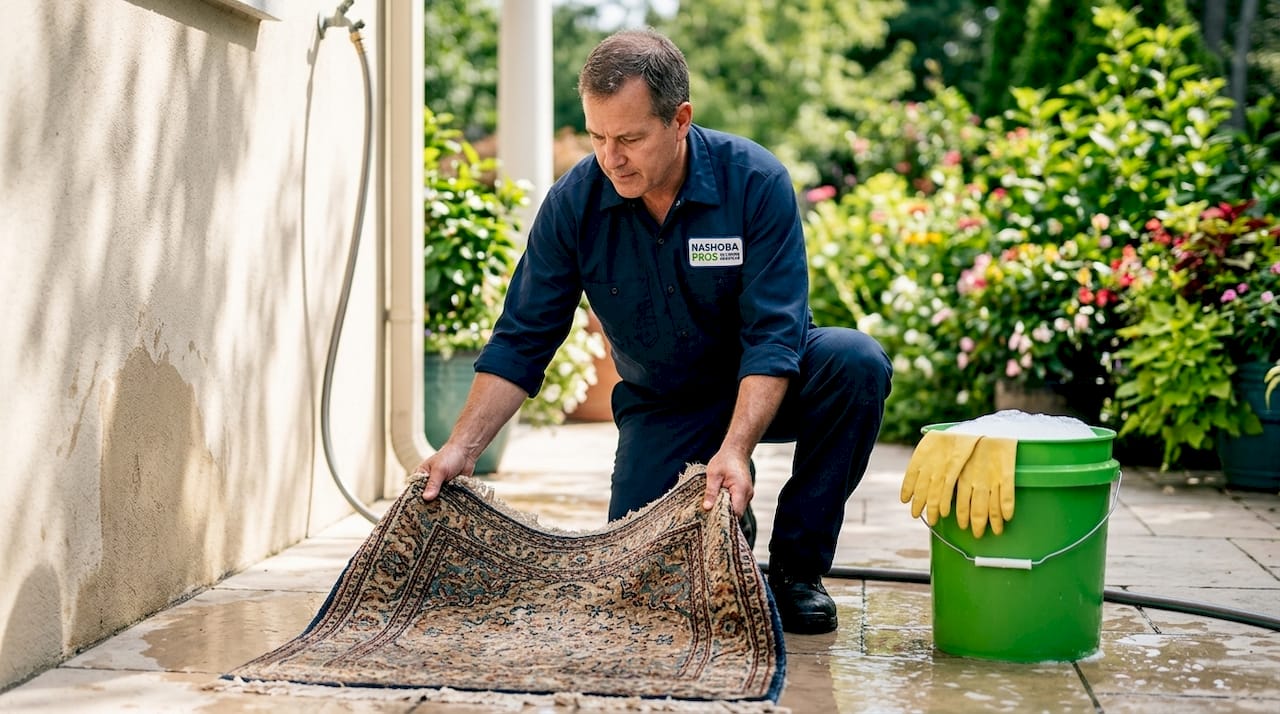
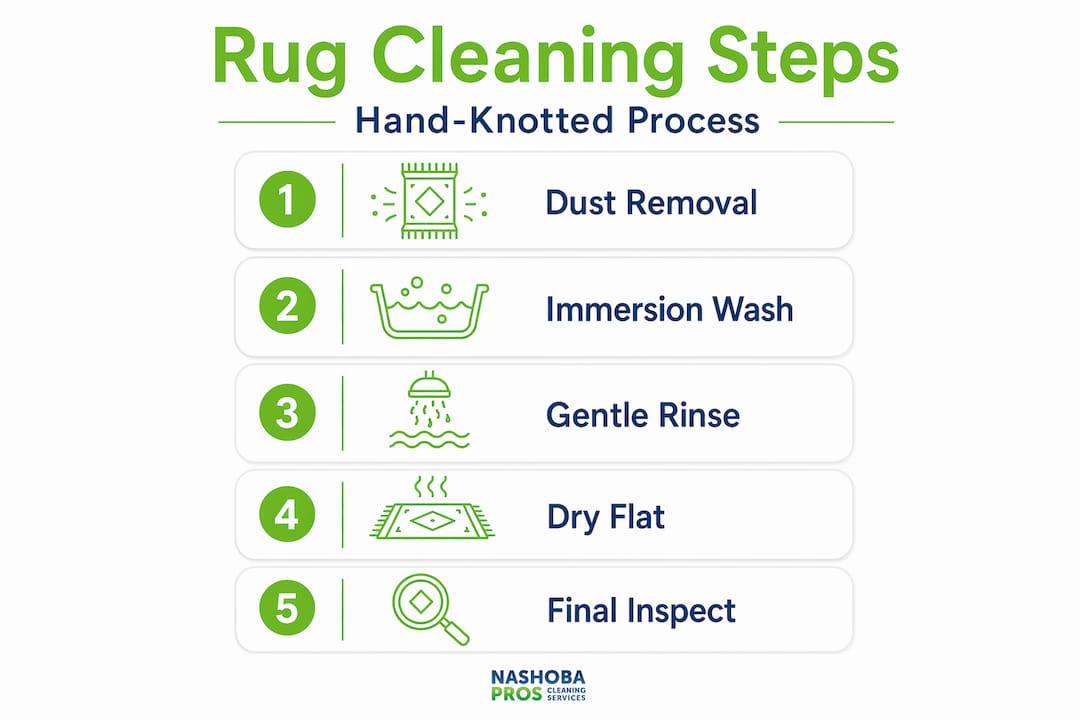
The industry term for what quality rug specialists do is “wet washing” or “full immersion washing.” It is nothing like running a steam cleaner over the surface. Here is what a proper professional cleaning actually involves.
-
Initial inspection and assessment. Before anything gets wet, a specialist examines the rug for pre-existing damage, loose fringe, color bleeding risk, and embedded debris. This step determines which cleaning agents are appropriate and whether any repairs need to happen before washing.
-
Dry dust removal. This is the step most homeowners never think about, and it is arguably the most important. Abrasive micro-dust settles deep inside fibers and acts like sandpaper against the knot structure with every footstep. Mechanical dusting, using a specialized dusting machine, pulls this particulate out before any moisture is introduced. Skipping this step and washing over embedded grit causes real fiber damage.
-
Full immersion hand washing. The rug is submerged in clean water and washed with pH-neutral, gentle shampoos designed for natural fibers. This staged process preserves delicate fibers and dyes while flushing out the deep-seated soil that no surface cleaning method can reach. Technicians work by hand, following the direction of the pile, never against it.
-
Thorough rinsing. Detergent residue left in a rug attracts new soil faster than a clean rug would. A professional rinse stage uses large volumes of clean water to flush the pile and foundation completely.
-
Controlled air drying. This is where amateurs often make costly mistakes. The rug is hung or laid flat with airflow both above and below the surface. Elevating the rug and circulating air speeds drying and prevents mold growth in the foundation or damage to any flooring underneath. No heat drying, no direct sunlight during this phase.
Here is a comparison of cleaning methods to help you see why full immersion is the standard for these rugs:
| Method | Suitable for hand-knotted rugs | Key risk |
|---|---|---|
| Full immersion wet washing | Yes | None when done professionally |
| Steam cleaning | No | Heat and moisture damage fibers and foundation |
| Dry powder cleaning | No | Residue accumulates in pile, attracts soil |
| DIY spot treatment only | Partial | Leaves embedded dirt, risks color bleeding |
Pro Tip: Ask any rug cleaner whether they perform full immersion washing off-site. If they clean your rug in place with a surface machine, that is not the right method for a hand-knotted piece.
At-home maintenance between professional cleanings
Professional washing handles the deep work, but what you do at home between those appointments determines how long your rug holds its color, texture, and structural integrity. Good hand-knotted rug maintenance is less about effort and more about knowing what to avoid.
Vacuuming is the most frequent task, and most people do it wrong. Vacuuming must be done in the direction of the pile using suction only. Never run a beater bar or rotating brush head over a hand-knotted rug. Those mechanical agitators are designed for synthetic carpet pile, and they catch and pull knots and fibers in ways that cause accelerated deterioration. A suction-only setting or a canister vacuum without a brush roll is the right tool.
For spills, the rule is simple but easy to forget in a panic: blot, never rub. Blotting with a white cloth and diluted mild detergent lifts the stain. Rubbing spreads it deeper into the pile and can break fibers. Work from the outer edge of the spill toward the center to avoid spreading.
A few other practices that protect your rug over the long term:
- Rotate the rug every six to twelve months. Foot traffic and sunlight exposure are rarely even across a rug’s surface. Rotating redistributes wear and prevents one area from fading or flattening faster than others.
- Use a quality rug pad. A pad prevents slipping, cushions the knot structure from hard floor contact, and allows airflow beneath the rug. This matters more than most people realize for fiber longevity.
- Keep it away from prolonged direct sunlight. Natural dyes, particularly in older or antique pieces, fade significantly with UV exposure. Curtains, UV-filtering window film, or simply repositioning the rug can prevent irreversible color loss.
- Reduce household dust accumulation. Airborne dust settles into rug fibers continuously. Strategies to reduce airborne dust in your home reduce the rate at which deep particulate builds up between cleanings.
Pro Tip: Never fold a hand-knotted rug for storage. Roll it with the pile facing inward, wrapped in breathable fabric, not plastic. Plastic traps moisture and invites mold.
Signs your rug needs professional attention
Knowing when to call a professional is just as important as knowing how to care for a rug at home. Professional cleaning is typically needed every one to three years depending on foot traffic, pets, and household activity, but certain signs mean you should not wait for that interval.
Watch for these specific indicators:
- Dull or muted color. When a rug looks flat or lackluster despite regular vacuuming, embedded soil is absorbing light that the fibers should be reflecting. This is almost always beyond what home care can address.
- Persistent odors. Odors that linger after vacuuming indicate soil or biological matter that has reached the foundation layer. Pet accidents in particular penetrate deeply and require professional flushing to remove completely.
- Fraying edges or loose fringe. This is structural damage. Continuing to vacuum or use a rug with fraying edges allows damage to spread inward. A rug specialist can repair fringe and re-secure edges before the problem becomes a restoration project.
- Color bleeding. If you see colors migrating outside their original boundaries, especially after any moisture exposure, stop using water-based treatments at home immediately. This requires professional assessment.
- Failed DIY stain removal. These signs indicate soil or damage beyond DIY cleaning capability. If a stain has not responded to correct blotting technique, professional treatment is the right next step, not more aggressive at-home attempts.
The timing of professional care matters more than most homeowners realize. Waiting until a rug looks obviously dirty means the damage is already well underway.
Why I think most homeowners wait too long
I have seen a lot of rugs come through the door over the years, and the pattern is consistent. By the time a homeowner decides to call a professional, the rug has usually been in decline for a year or two already. The color looks a bit flat. There is a faint smell they’ve gotten used to. The edges are starting to show wear.
What I’ve learned is that DIY harsh cleaning methods cause irreversible asset depreciation by stripping natural lanolin and damaging dyes in ways that no amount of professional cleaning can fully reverse. The rug I see after someone has used a rented steam cleaner or an off-the-shelf carpet spray is not the same rug it was before. Some of that damage is permanent.
My honest take: the homeowners who treat their hand-knotted rugs the way collectors treat art, with scheduled professional maintenance and careful daily habits, almost never have a crisis. Their rugs still look vibrant after twenty years. The homeowners who wait for a visible problem often discover that by then, the cost of restoration far exceeds what regular cleaning would have cost.
Professional cleaning is not an expense. It is the maintenance that protects an investment you have already made.
— Jim
Protect your rug with Nashobapros
If you have a hand-knotted rug that is due for professional care, or one that has been showing the warning signs above, Nashobapros is ready to help. We have been handling oriental rug cleaning for homeowners in Westford, MA and the Nashoba Valley area for over 30 years, using methods that protect natural fibers, preserve dyes, and restore the appearance your rug had when it was at its best.

Every product we use is pet-safe and family-safe. We inspect each rug carefully before cleaning, explain exactly what we find, and never recommend services you do not need. If you are ready to schedule a cleaning or just want to know what your rug needs, call us or book online today. Most appointments can be scheduled within days, and the difference in your rug’s appearance after a professional wash is something you will notice immediately.
FAQ
How often should hand-knotted rugs be professionally cleaned?
Most hand-knotted rugs need professional cleaning every one to three years, depending on foot traffic and household use. Weekly vacuuming and prompt spill treatment help extend the interval between professional washings.
Can I steam clean a hand-knotted rug at home?
No. Steam cleaning applies heat and moisture that can damage natural fibers, shrink cotton foundations, and cause color bleeding. Full immersion hand washing by a trained specialist is the correct method for cleaning hand-knotted rugs.
What is the safest way to vacuum a hand-knotted rug?
Use suction only, no beater bar, and always vacuum in the direction of the pile. Gentle weekly vacuuming with low suction prevents deep soil buildup without damaging the knot structure.
What should I do immediately after a spill on a hand-knotted rug?
Blot the spill immediately with a clean white cloth, working from the outside of the spill toward the center. Avoid rubbing, which pushes the stain deeper into the pile and can break fibers.
How do I know if my hand-knotted rug needs repair, not just cleaning?
Fraying edges, loose fringe, and color that bleeds when wet are signs of structural or dye damage that go beyond cleaning. A professional specialist should assess the rug before any washing is done to determine whether repair is needed first.