

How Carpet Construction Affects Cleaning Results
Carpet construction is the single biggest factor determining how well your carpet cleans and how long it lasts. The fiber type, pile structure, and weave pattern your carpet uses dictate which cleaning methods work, which ones cause damage, and how deeply soil embeds before you ever run a vacuum. Nylon, wool, polyester, and olefin each behave differently under cleaning agents, moisture, and agitation. Understanding how carpet construction affects cleaning results lets you stop guessing and start making decisions that protect your investment and your family’s health. Professional hot water extraction, when matched to the right fiber type, reduces indoor allergens by up to 96% and extends carpet lifespan by more than 50%.
How carpet construction affects soil retention and cleaning challenges
Carpet construction is not just about appearance. It determines how soil enters the fiber, how deep it travels, and how resistant it is to removal.
Fiber types and their cleaning chemistry
Nylon is the most durable synthetic fiber and responds well to hot water extraction. Its molecular structure resists crushing and holds dye tightly, which means it tolerates a wider range of cleaning agents without color loss. Polyester repels water-based stains effectively but holds oily soils deep in the fiber, making it harder to clean thoroughly without the right degreasing agents. Olefin (also called polypropylene) is highly moisture-resistant but attracts oily residue at the molecular level, which is why olefin carpets in high-traffic areas look gray and dingy faster than nylon. Wool is the most chemically sensitive fiber of all. Using a high-alkaline cleaner on wool causes fiber damage and discoloration. Wool requires pH-neutral or mildly acidic cleaning agents to stay intact.
Carpet cleaning success depends on matching fiber chemistry to cleaning agent pH. Get that wrong and you are not just cleaning poorly. You are actively damaging the carpet.
Weave and pile structure
The physical construction of the pile changes how soil embeds and how it responds to agitation.
- Cut pile (including plush and Saxony styles) has open fiber tips that trap fine particles deep in the pile. These carpets clean well with hot water extraction because the open structure allows water and cleaning agents to penetrate and flush soil out.
- Loop pile (Berber and level loop) holds soil near the surface initially, but the closed loops make it harder for extraction equipment to pull particles out from the base. Excessive agitation on looped constructions causes fiber snagging and permanent texture loss.
- Cut-and-loop combinations create textured patterns but also create uneven soil pockets that require careful, low-agitation cleaning to avoid distorting the design.
Pro Tip: Ask your carpet manufacturer or installer for the fiber content and pile construction before scheduling any professional cleaning. That single piece of information changes every decision your cleaner makes.
Which cleaning method works best for your carpet type?
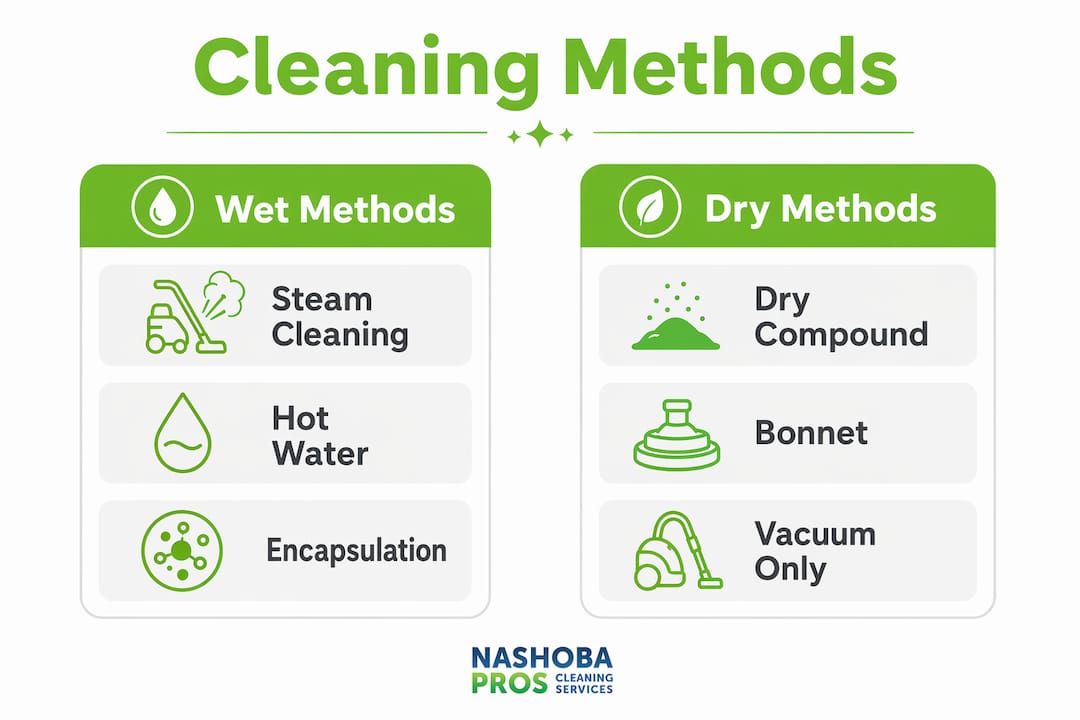
The four main carpet cleaning methods each interact with fiber and construction differently. Choosing the wrong one does not just reduce results. It can shorten your carpet’s life.
| Method | Best For | Avoid With | Key Trade-Off |
|---|---|---|---|
| Hot water extraction (steam cleaning) | Nylon, cut pile, heavily soiled carpets | Delicate wool, thin backing | Drying time of 4–12 hours; deepest clean available |
| Encapsulation | Olefin, commercial loop pile, light soil | Heavily soiled or pet-affected carpet | Fast drying; does not remove deep soil |
| Dry cleaning (compound method) | Wool, delicate fibers, low-moisture needs | High-traffic nylon with embedded grit | Minimal moisture risk; surface-level clean only |
| Bonnet cleaning | Commercial cut pile, interim maintenance | Residential plush, Berber | Fast but leaves residue that attracts soil |
Hot water extraction delivers the deepest clean of any method. The trade-off is drying time. That 4–12 hour window matters because carpet backing absorbs moisture from over-wetting, which causes browning, mold growth, and structural damage over time. A professional with the right truck-mounted equipment extracts enough water to cut that drying window significantly compared to rental machines.
Encapsulation works by surrounding soil particles in a crystallizing polymer that releases from the fiber when vacuumed. It is a solid maintenance method for commercial olefin or loop pile carpets but does not flush allergens and fine particles from the base of the pile the way extraction does.
Dry cleaning uses an absorbent compound worked into the pile, then vacuumed out. It is the safest choice for wool and other moisture-sensitive fibers, but it cleans only the upper portion of the pile. For a carpet with years of embedded grit, dry cleaning is maintenance, not restoration.
Pro Tip: For comparing steam vs. other methods in detail, the fiber type and backing material should be your first filter, not price or convenience.
Carpet maintenance tips matched to your carpet’s construction
The right maintenance approach depends entirely on what your carpet is made of. Generic advice about vacuuming twice a week ignores the fact that a Berber loop pile and a plush nylon cut pile need completely different tools and techniques.
-
Vacuum with the right tool for your pile type. Cut pile carpets benefit from upright vacuums with beater bars, which agitate fibers and release embedded particles. Loop pile and Berber carpets require suction-only vacuums or vacuums with the beater bar turned off. Running a beater bar over Berber is one of the fastest ways to snag and distort the loops permanently.
-
Treat stains with fiber-appropriate chemistry. Wool needs pH-neutral spot cleaners. Nylon tolerates mild alkaline solutions. Polyester stains from oily sources need a solvent-based spotter, not a water-based one. Applying the wrong product does not just fail to remove the stain. It can set it permanently or bleach the fiber.
-
Schedule professional cleaning on a fiber-based timeline. Carpet manufacturers recommend professional cleaning every 12–18 months, with pet owners and high-traffic households needing more frequent service. Wool and delicate fibers may need gentler, more frequent light cleaning rather than infrequent deep cleaning. Check your recommended cleaning intervals based on your specific carpet type and household conditions.
-
Place walk-off mats at every entry point. High-quality walk-off mats reduce tracked-in dirt by 50% or more. That reduction matters most for loop pile and Berber constructions, where soil embeds near the base and is hardest to extract.
-
Rotate furniture every 6–12 months. Concentrated foot traffic compresses pile fibers permanently. Rotating furniture and using furniture coasters distributes wear evenly and prevents the flattened, matted look that no cleaning can reverse.
-
Do not wait for visible dirt. Abrasive soil micro-scratches fiber surfaces and causes premature wear long before the carpet looks dirty. By the time you can see the grime, the damage is already accumulating. Proactive cleaning stops that cycle before it becomes permanent.
Pro Tip: Pre-treatment is not optional for heavily soiled carpets. The role of pre-treatment in cleaning results is especially significant for polyester and olefin fibers, where oily soil bonds tightly to the fiber and resists plain water extraction.
Does carpet type affect indoor air quality and health?
Carpet is not just a floor covering. It acts as a passive air filter, trapping allergens, pet dander, dust mites, and fine particulates that would otherwise stay airborne. The fiber type and construction determine how much it traps and how easily those contaminants release during cleaning.
- Cut pile carpets trap more fine particles deep in the pile due to their open fiber tips. This makes them effective at pulling allergens out of the air, but it also means those allergens stay embedded until a thorough extraction cleaning removes them.
- Loop pile and Berber hold particles closer to the surface, which makes them easier to vacuum regularly but harder to deep-clean when soil reaches the base of the loops.
- Wool has natural antimicrobial properties that resist dust mite colonization better than synthetic fibers, making it a strong choice for allergy-sensitive households when maintained correctly.
- Synthetic fibers like polyester and olefin do not have wool’s natural resistance, so they rely entirely on cleaning frequency and method to manage allergen load.
Professional cleaning removes embedded contaminants that surface vacuuming cannot reach. This is a health improvement process, not just a cosmetic one. For pet owners and allergy sufferers, the connection between indoor air quality and carpet cleanliness is direct and measurable.
One risk that homeowners consistently underestimate is residue buildup. Improper detergent removal bonds soil particles to fibers and causes rapid resoiling, making carpets look dirty within days of cleaning. This is not a cleaning failure. It is a rinsing failure, and it is far more common with DIY rental machines than with professional truck-mounted equipment.
Moisture management is the other critical factor. Owners often underestimate the carpet backing’s role in odor and mold problems caused by over-wetting. A carpet that dries slowly after cleaning creates the exact conditions mold needs to grow. Proper extraction technique and adequate airflow after cleaning are not optional steps. They are what separates a clean carpet from a health problem.
Key takeaways
Carpet construction determines cleaning method, cleaning frequency, and long-term fiber health. Matching fiber type to the right method and schedule is the only way to get consistent results.
| Point | Details |
|---|---|
| Fiber chemistry drives method choice | Wool needs pH-neutral cleaners; nylon tolerates extraction; polyester needs solvent-based spotters for oily stains. |
| Pile structure changes agitation rules | Loop pile requires suction-only vacuuming; cut pile benefits from beater bar agitation to release embedded particles. |
| Drying time is a health factor | Over-wetting carpet backing causes mold, browning, and odor; professional extraction reduces drying time significantly. |
| Proactive cleaning prevents fiber damage | Abrasive soil scratches fibers before carpets look dirty; cleaning every 12–18 months stops permanent wear. |
| Residue causes rapid resoiling | Incomplete detergent removal bonds new soil to fibers; professional rinsing prevents this cycle. |
What 30 years of carpet cleaning taught me about construction
The most common mistake I see homeowners make is treating all carpets as if they are the same material. They rent a machine, use whatever cleaning solution comes with it, and then wonder why their Berber looks worse after cleaning than before. The answer is almost always a mismatch between the cleaning method and the carpet’s construction.
What surprises most people is that the backing matters as much as the fiber on top. I have seen beautiful wool carpets develop brown staining and a musty smell not because the cleaning agent was wrong, but because the backing stayed wet for 36 hours. The fiber looked fine. The backing was already growing mold.
The other thing I would push back on is the idea that professional cleaning is a luxury. When you understand that abrasive soil is physically cutting your fiber every day it sits there, the math changes. A cleaning every 12–18 months is not maintenance. It is damage prevention. The carpets I have seen last 20 years or more all had one thing in common: their owners cleaned them before they looked dirty, not after.
My honest recommendation is to find a professional who asks about your fiber type before quoting a method. If they do not ask, they are not matching the method to your carpet. That is the single question that separates a cleaner who understands carpet science from one who just runs a machine.
— Jim
Get fiber-specific carpet cleaning from Nashobapros
Nashobapros has served Westford, MA and the surrounding Nashoba Valley communities for over 30 years. Every carpet cleaning job starts with identifying your fiber type and construction, because that determines the method, the chemistry, and the drying approach we use.

Our truck-mounted hot water extraction equipment delivers the deep clean that nylon and cut pile carpets need, while our low-moisture methods protect wool and delicate loop pile constructions. Not sure how often your specific carpet needs professional attention? Our professional cleaning frequency guide breaks it down by fiber type and household conditions. We also handle carpet cleaning in Cambridge, MA and surrounding areas. Every product we use is pet-safe and family-safe. Call us or book online for a free quote. Most jobs are scheduled within days.
FAQ
What carpet fiber is the easiest to clean?
Nylon is the easiest carpet fiber to clean because its molecular structure resists crushing, holds dye tightly, and tolerates a wide range of cleaning agents including hot water extraction.
Can the wrong cleaning method damage my carpet permanently?
Yes. Using a high-alkaline cleaner on wool causes fiber damage and discoloration, and running a beater bar over loop pile carpets causes irreversible snagging and texture distortion.
How does carpet construction affect allergen removal?
Cut pile carpets trap allergens deep in the pile, requiring hot water extraction to remove them fully. Professional extraction reduces indoor allergens by up to 96%, far beyond what vacuuming alone achieves.
Why does my carpet look dirty right after cleaning?
Residue from incomplete detergent removal bonds soil particles to fibers and causes rapid resoiling. This is most common with rental machines that lack the extraction power to fully rinse cleaning agents from the pile.
How often should i have my carpet professionally cleaned?
Carpet manufacturers recommend professional cleaning every 12–18 months for most fiber types. Pet owners and high-traffic households need more frequent service to prevent abrasive soil from permanently damaging fibers.